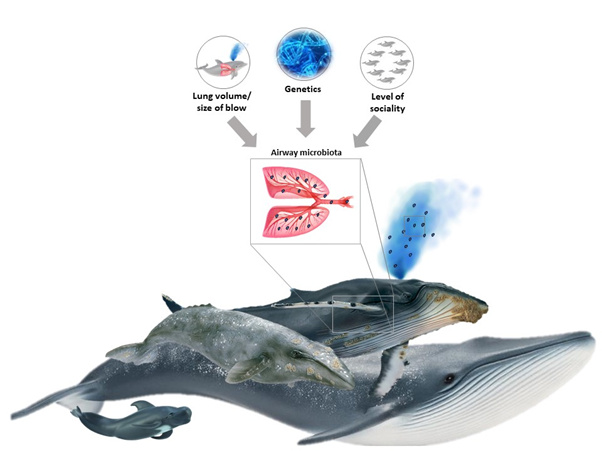
Dear Colleagues, We are pleased to announce the following paper recently published in Environmental Microbiology Reports: Does sociality drive diversity and composition of airway microbiota in cetaceans? It is a well-research fact that sociality drives the community composition of gut bacteria in mammals. If this correlation however applies to the microbiota of the airways is still unclear. We tested this hypothesis for the airway microbiota of whale species with differing levels of sociality. Link: https://sfamjournals.onlinelibrary.wiley.com/doi/abs/10.1111/1758-2229.12835 Citation: Vendl, C., Slavich, E., Nelson, T., Acevedo‐Whitehouse, K., Montgomery, K., Ferrari, B., Thomas, T. and Rogers, T., 2020. Does sociality drive diversity and composition of airway microbiota in cetaceans?. Environmental Microbiology Reports. Graphical abstract: [cid:d592fff6-3512-4318-8a8f-2f9ba48af32f] Summary The number of social contacts of mammals is positively correlated with the diversity of their gut microbes. There is some evidence that sociality also affects microbes in the respiratory tract. We tested whether the airway microbiota of cetacean species differ depending on the whales’ level of sociality. We sampled the blow of blue (Balaenoptera musculus), gray (Eschrichtius robustus), humpback (Megaptera novaeangliae) and long-finned pilot whales (Globicephala melas) and analysed the blow microbiota by barcode tag sequencing targeting the V4 region of the bacterial 16S rRNA gene. Humpback whales show higher levels of sociality than blue and gray whales, while pilot whales are the most gregarious amongst the four species. The blow samples of the humpback whales showed the highest richness and diversity. Humpback whales were also the only species with a species-specific clustering of their microbial community composition and a relatively large number of core taxa. Therefore, we conclude that it cannot be sociality alone shaping the diversity and composition of airway microbiota. We suggest the whale species’ lung volume and size of the plume of exhaled air as an additional factor impacting the transmission potential of blow microbiota from one individual whale to another.