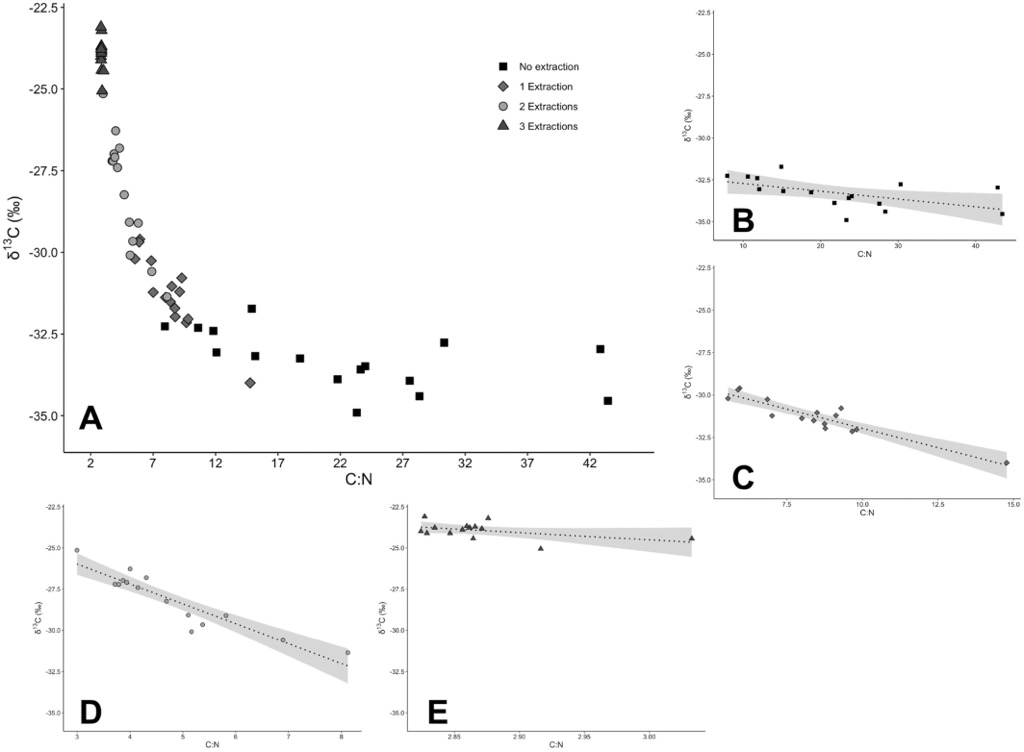
Dear MARMAM community, On behalf of my co-authors, I am pleased to share our latest research, published in Ecology and Evolution, with you. Groß, J., B. Fry, J. Eggebo, and S. Bengtson Nash. 2026. “Influence of Solvent Lipid Extraction on Tissue-Specific Carbon Isotopes.” Ecology and Evolution 16, no. 6: e73829. https://doi.org/10.1002/ece3.73829. https://doi.org/10.1002/ece3.73829 Influence of Solvent Lipid Extraction on Tissue‐Specific Carbon Isotopes doi.org ABSTRACT: Cetacean blubber and skin have a high lipid content, which is depleted in 13C and 15N compared to proteins. As such, it is necessary to normalise samples for lipids prior to bulk stable isotope analysis. This is often achieved via solvent lipid removal. The direct effects of solvents used in lipid extractions on δ15N of animal tissue is a widely discussed topic in the fields of stable isotope and cetacean trophic ecology. The effects of such solvents on δ13C on the other hand, beyond the desired effect of lipid removal, have not yet been studied, although outcomes may be as unpredictable as those found for δ15N. Here, we evaluate the effects of solvent lipid extraction on four pure proteins, as well as humpback whale blubber tissue. Lipids were extracted multiple times prior to stable isotope analysis, which also served to demonstrate the efficiency of each lipid extraction cycle. Our results showed that the solvents used, dichloromethane and methanol, did not have a significant effect on δ13C and δ15N of pure protein as values largely remained within 0.5‰ of unextracted samples, which is equivalent to the expected analytical error. Humpback whale blubber δ13C, on the other hand, increased significantly with each lipid extraction cycle, and C:N ratios were only equivalent to those of pure protein, 2.87, after three lipid extractions. These results highlight that solvent lipid extraction has no effect on δ13C beyond the desired effect of lipid removal but that gentle lipid extraction protocols are inefficient and that multiple lipid extraction cycles are required to achieve robust isotopic measures. Cheers, Jasmin — — Dr Jasmin Groß (she/her) Postdoctoral Research Fellow #CallMeByMyFirstName I Fulbright Alumna I SOPOPP Alumna | HIFMB Alumna | Email <mailto:jasmin.gross@fulbrightmail.org> OrcID <https://orcid.org/0000-0002-1078-043X>