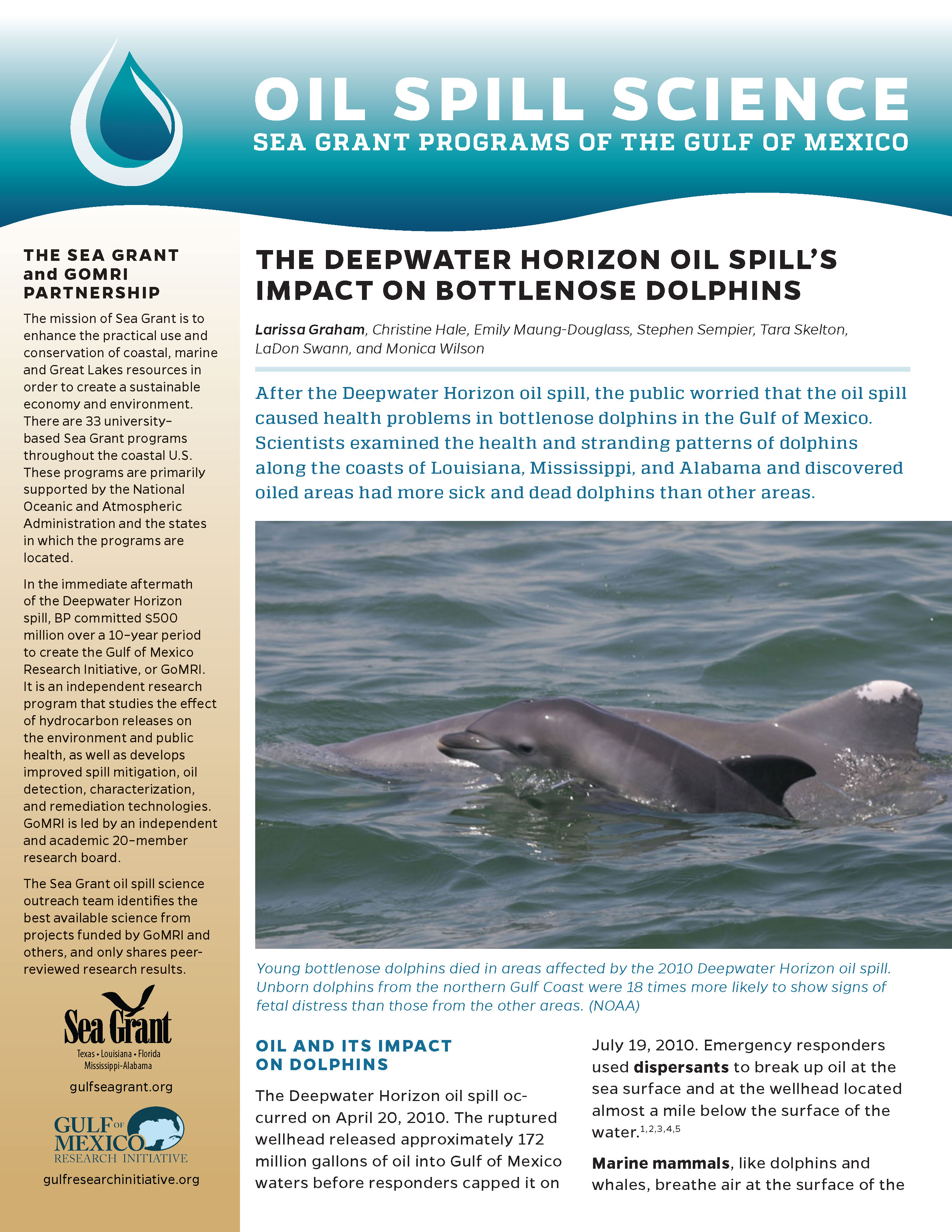
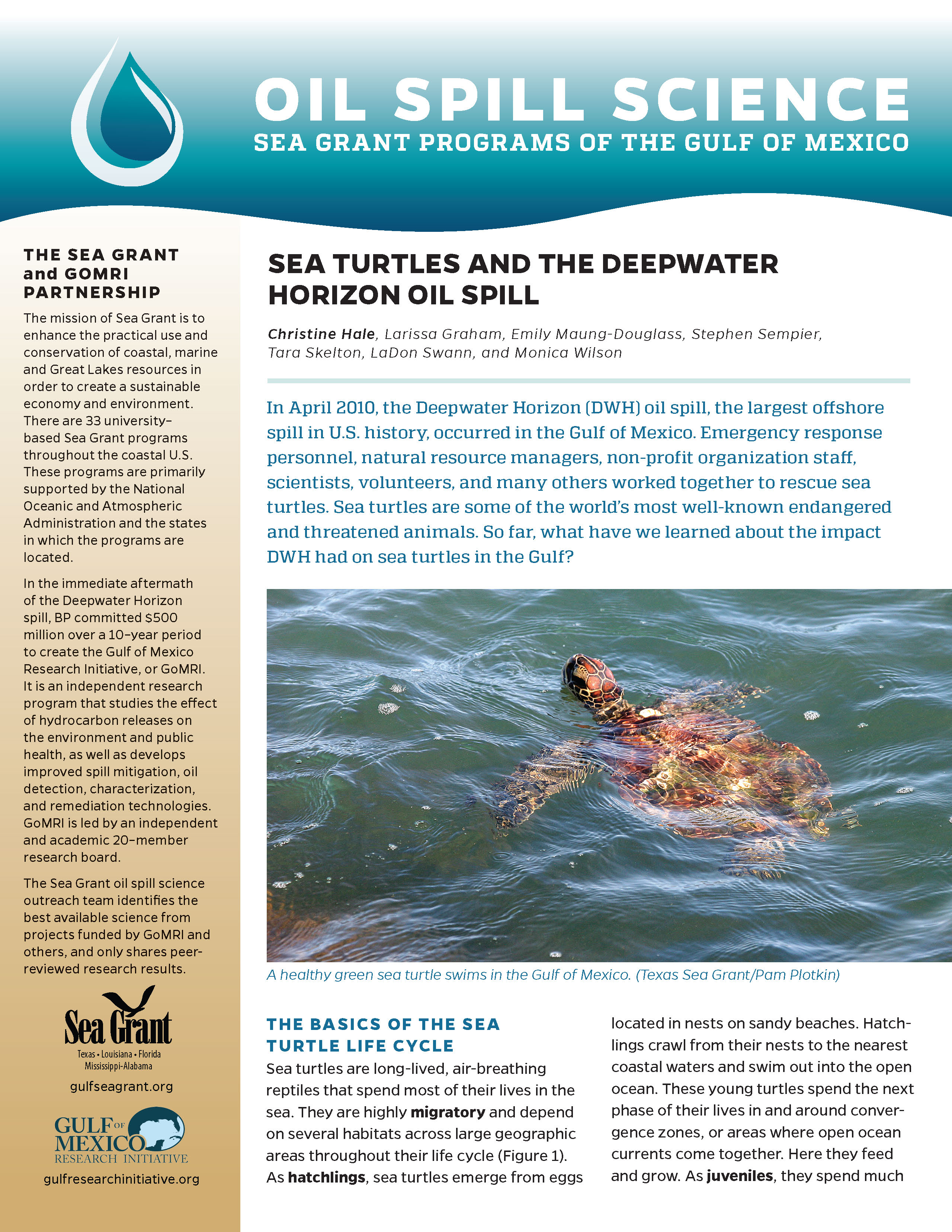
Sea Grant team summarizes Deepwater Horizon impacts on dolphins and sea turtles in new offerings Two popular marine animals-dolphins and sea turtles-are the focus of new publications<https://gulfseagrant.wordpress.com/oilspilloutreach/publications/> from the Sea Grant Oil Spill Science Outreach Team<https://gulfseagrant.wordpress.com/oilspilloutreach/contact-a-member-of-the-oil-spill-outreach-project/>. In the aftermath of the largest oil spill in history, many expressed concern about its impact on these long-lived, slow-to-mature creatures. Now, almost seven years after the spill, scientists have a better understanding of how they fared. The team examined this research, synthesizing peer-reviewed findings into two easy-to-understand outreach bulletins. Starting in 2010 a month before the Macondo blowout, scientists documented more than 1,000 stranded dolphins and whales along the northern Gulf of Mexico. From 2010 until 2014, they examined the health and stranding patterns of dolphins along the coasts of Louisiana, Mississippi, Alabama, and Florida, discovering that oiled areas had more sick and dead dolphins. Scientists also found many sick and stranded pre-term and newborn dolphins. Overall, young dolphins in the study area were eight times more likely to have pneumonia or inflamed lungs and 18 times more likely to show signs of fetal distress than those from areas outside the Gulf. "The Deepwater Horizon's impact on bottlenose dolphins"<http://masgc.org/oilscience/oil-spill-science-dolphins.pdf> examines all of the factors, including oil, that scientists think contributed to dolphin populations' drop in numbers during this time. "Sea turtles and the Deepwater Horizon oil spill"<http://masgc.org/oilscience/oil-spill-science-sea-turtles.pdf> details 2010's impacts on threatened or endangered sea turtles species in the Gulf. In total, scientists estimate that the oil spill and related response activities killed between 95,000 and 200,000 sea turtles. Lasting impacts of these losses may take time to become clear. For example, scientists do not fully understand how oil exposure affects sea turtles' ongoing reproductive abilities. They continue to monitor sea turtle populations by counting numbers of nests, hatchlings, and adult females on beaches. In late March, the team hosted a day-long seminar on sea turtles and oil spills in Brownsville, Texas. More than 100 participants gathered in person and online to listen to scientists, responders, and other sea turtle experts explain what we know about how these creatures fared in 2010 and detail ongoing conservation programs. Videos of the presentations<http://gulfseagrant.org/sea-turtles-oil-spills/> are available on the oil spill science outreach website<https://gulfseagrant.wordpress.com/oilspilloutreach/>. The Sea Grant Oil Spill Science Outreach Program<https://gulfseagrant.wordpress.com/oilspilloutreach/> is a joint project of the four Gulf of Mexico Sea Grant College Programs<https://gulfseagrant.wordpress.com/>, with funding from partner Gulf of Mexico Research Initiative<http://gulfresearchinitiative.org/>. The team's mission is to collect and translate the latest peer-reviewed research for those who rely on a healthy Gulf for work or recreation. To learn more about the team's products and presentations, visit gulfseagrant.org/oilspillscience<https://gulfseagrant.wordpress.com/oilspilloutreach/>. Tara Skelton Oil Spill Science Outreach Team Communicator Mississippi-Alabama Sea Grant Consortium 703 East Beach Drive Ocean Springs, MS 39564 228.818.8825 (office) 228.327.5284 (mobile) tara.skelton@usm.edu