New publication: How loud are drones underwater?

Dear MARMAMers, this might be interesting to all of you that use drones as part of your research: I'm pleased to announce on behalf of my co-authors a new publication on the sound of drones underwater, published in JASA. We flew three different DJI drones (Inspire, Phantom, Mavic) at different heights and horizontal distances over a hydrophone and measured their sound underwater. The drones all sound very different and depending on your species of interest you should choose your drone appropriately. Depending on the animal and on the distance, the drones may well be audible underwater! Also, flying higher above the animal reduces the sound but flying away horizontally reduces it much much more. So, whenever possible, stay behind or next to the animal to reduce potential impacts. If you're interested in the paper, check out the story behind it and the lay summary on our blog: https://whalewise.org/blog-2/ Or check out the article online: https://doi.org/10.1121/10.0019805 Or ask Amelie for a copy (amelie-laute@gmx.de) Laute A, Glarou M, Dodds F, Røsand SCG, Grove TJ, Stoller A, Rasmussen MH, Smith A, Loisa O and Fournet MEH (2023). Underwater sound of three unoccupied aerial vehicles at varying altitudes and horizontal distances. *JASA (Journal of the Acoustical Society of America)*, 153:3419. https://doi.org/10.1121/10.0019805. ABSTRACT: Unoccupied aerial vehicles (UAVs), or “drones,” are increasingly used as a tool for cetacean research, but knowledge about how these tools contribute to underwater sound is lacking. In this study, underwater sound levels of three commonly used UAV models (Mavic Pro Platinum, Phantom 4 Pro v2.0, Inspire 1 Pro) were recorded. For each model, three replicate flights were conducted at 36 positions at standardized horizontal (0–30 m) and vertical (2–40 m) distances from a hydrophone (1m depth). Median broadband received levels of the Inspire were highest at 96.5 dBrms 141–17 783 Hz re 1 lPa2, followed by the Phantom (92.4 dBrms 141–17 783 Hz re 1 lPa2) and Mavic, which was quietest (85.9 dBrms 141–17 783 Hz re 1 lPa2). Median ambient sound levels in the absence of an UAV were 82.7 dBrms 141–17 783 Hz re 1 lPa2. Significant increases in ambient sound levels associated with UAV flights occurred at higher altitudes than previously reported, and received levels decreased more with increasing horizontal distance of the UAV than with altitude. To minimize potential noise impacts on sensitive marine animal subjects, we recommend increasing horizontal distance to the animal, rather than altitude, and choosing the quietest UAV feasible. Best Amelie Laute

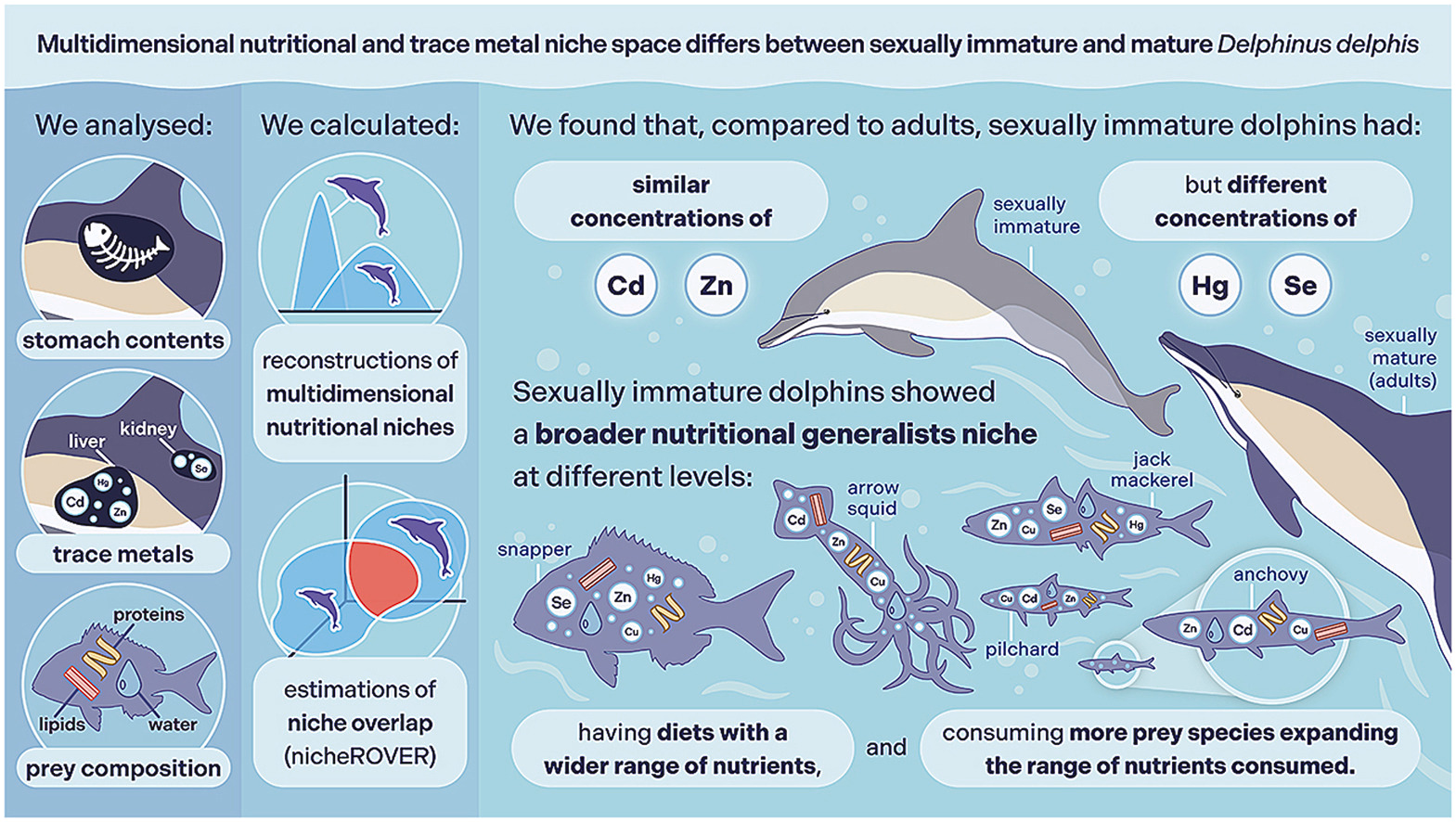
Dear MARMAMers, Our latest open access article is now available online Stockin KA, Machovsky-Capuska GE, Palmer EI, Amiot C (2023). Multidimensional trace metals and nutritional niche differ between sexually immature and mature common dolphins (Delphinus delphis). Environmental Pollution 333: 121935. https://doi.org/10.1016/j.envpol.2023.121935 [cid:image001.png@01D9B74E.A2C7B770] ABSTRACT: There is a need to understand the links between metals and nutrition for apex marine predators, which may be subject to different ecotoxicological effects at different life stages. We combined stomach content analyses (SCA), prey composition analysis (PCA), the Multidimensional Niche Framework (MNNF) with Bayesian multivariate ellipses, trace metal analysis and nicheROVER to investigate nutrition and trace metals across sex, age, and sexual maturity status in common dolphins (Delphinus delphis) from New Zealand. A broader prey composition niche breadth (SEAc) was estimated for immature compared to mature conspecifics, showing a higher degree of prey and nutrient generalism driven by protein (P) intake. Cd and Zn niche similarities suggests these metals were incorporated through similar prey in both immature and mature dolphins, whereas Hg and Se niche divergence indicates uptake occurred via different prey. Our multidisciplinary assessment demonstrated how nutrients and metal interactions differ in common dolphins depending upon sexual maturity. This approach has relevance when considering how marine pollution, environmental fluctuations and climate change may affect nutritional and trace metal interactions during different reproductive stages within marine predators. nāku noa, Karen Karen A Stockin, PhD Professor – Marine Biology Rutherford Discovery Fellow – Royal Society Te Aparangi Cetacean Ecology Research Group | School of Natural Sciences | Massey University Private Bag 102 904, North Shore, Auckland 0745, New Zealand Physical Address: Cetacean Research Unit, 5 University Avenue, Massey University, Albany, North Shore, Auckland [cid:image002.png@01D9B74E.A2C7B770] +64 (0)21 423997 • k.a.stockin@massey.ac.nz<mailto:k.a.stockin@massey.ac.nz> • http://www.cetaceanecology.org<http://www.cetaceanecology.org/> [cid:image003.png@01D9B74E.A2C7B770]<https://www.researchgate.net/profile/Karen_Stockin> [cid:image004.png@01D9B74E.A2C7B770] <https://scholar.google.co.nz/citations?user=3veDZKUAAAAJ&hl=en> [cid:image005.png@01D9B74E.A2C7B770] <https://twitter.com/karen_stockin> [cid:image006.png@01D9B74E.A2C7B770] <https://www.facebook.com/CetaceanEcologyOrg/posts/3281214818613245> [cid:image007.png@01D9B74E.A2C7B770] <https://www.massey.ac.nz/massey/expertise/profile.cfm?stref=926050> [cid:image008.png@01D9B74E.A2C7B770] <https://www.massey.ac.nz/massey/explore/research/animal-veterinary/animal/marine/marine_home.cfm> [cid:image009.png@01D9B74E.A2C7B770]<https://www.cetaceanecology.org/>






participants (2)
-
 Amelie Laute
 -
 Karen Stockin