One more atypical mass stranding of Cuvier's beaked whales in Greece (SE Crete, Hellenic Trench) during military exercise

Dear all, Once more we have bad news regarding Cuvier's beaked whales in the Greek Seas. The local population unit, which has repeatedly been affected by naval sonar activity of NATO or of national navies in the past may be steadily heading towards its extinction. Today 1st April 2014 between 12:00 and 13:30 pm at least five Cuvier's beaked whales stranded atypically so far in the area of Ierapetra, SE Crete. Three animals stranded together in the same location and two other individuals stranded together some 17 km further west. Two more individuals stranded as single individuals 2.7 km and 500 m further west along the coast, but there is no way to know if these were additional individuals or some of those already stranded earlier. All animals were alive when stranded. One of them died and all other were led offshore by local people and not seen again until now. After a quick search in the internet we found that the Israeli, Greek and US Navy are conducting a trilateral two-week military exercises in the area of Crete (named Noble Dina 2014). The naval activity includes anti-submarine warfare (ASW), which indicates the use of military sonar, well known as the cause of many mass strandings of Ziphiids around the world. During their 5^th Meeting of the Parties (Morocco, November 2013)the Agreement for the Conservation of Cetaceans in the Mediterranean and Black Sea (ACCOBAMS) have for first time identified on a map the areas where sonar should be avoided in the Mediterranean Sea, and made this information publicly available. One of these areas on the map is SE Crete where the new mass stranding occurred. A bit earlier we contacted competent Greek authorities including the Greek focal point of ACCOBAMS to inform them about the new mass stranding and to request their intervention, so that no use of military sonar is made during the exercise today and following days. The port-police authorities and local volunteers have been alerted and we just hope that tomorrow we won't find more animals along the coasts. *How many more whale deaths to spark real mitigation at the regional and international level?* Best wishes, Alexandros -- ___________________________________________ Dr. Alexandros Frantzis Scientific director Pelagos Cetacean Research Institute Terpsichoris 21 16671 Vouliagmeni, GREECE Tel.: +30-210-8960108 e-mail: afrantzis@otenet.gr website: http://www.pelagosinstitute.gr ___________________________________________ --- This email is free from viruses and malware because avast! Antivirus protection is active. http://www.avast.com
Dear all, Following the many tens of e-mails that we received, we would like to express our gratitude for your interest and support and answer some of your questions with an update, now that more data are available. The atypical mass stranding spanned 2 days (1st and 2nd April ) and involved five single stranding events involving 3, 2, 1, 1 and 1 individuals. According to the analysis conducted so far, a minimum of five (but analysis is on going) and a maximum of seven individuals were recorded (two single standing events concerned the same individual and the two individuals of another event cannot be identified). The distance between the western and eastern stranding locations for the strandings of the 1st April was 16.5 km in straight line. The single stranding of the 2nd of April occurred 4.1 km further west of the western stranding location of the 1st of April. /(While writing this message and according to preliminary information from the local port-police authorities, three more reports of three different stranding events became available. They occurred the 3rd or 4th, the 5th and 6th April and all involved single animals. The two first concerned live animals re-floated and the last one (today 6th April) a dead animal still being on the beach. All of them occurred at a distance of less than 1 km between each other and took place in a location about 48 km west of the stranding event of the 2nd of April. These news are very important and indicate that the impact of the exercise may concern a very large sea area./)* * Two of the stranded whales died (all others were re-floated and not seen so far) and necropsies were performed on both of them (the whale that was disposed according to our first message was recovered). The necropsies were conducted under the guidance of Dr. Anastasia Komnenou, Veterinary School of Aristotle University of Thessaloniki. Please address any questions regarding the necropsies and the histopathological findings directly to her. At least one of the photos of the stranding event is amazing and can greatly contribute to the conservation of beaked whales. Therefore, we thought that sharing it with the entire cetological community can help our common goal to protect the beaked whales from navy sonar and anthropogenic sound in general. Please feel free to upload and distribute the photo as attached to raise public awareness or for educational purposes (you have no right of use for commercial purposes). All best, Alexandros -- ___________________________________________ Dr. Alexandros Frantzis Scientific director Pelagos Cetacean Research Institute Terpsichoris 21 16671 Vouliagmeni, GREECE Tel.: +30-210-8960108 e-mail:afrantzis@otenet.gr website:http://www.pelagosinstitute.gr ___________________________________________ --- This email is free from viruses and malware because avast! Antivirus protection is active. http://www.avast.com
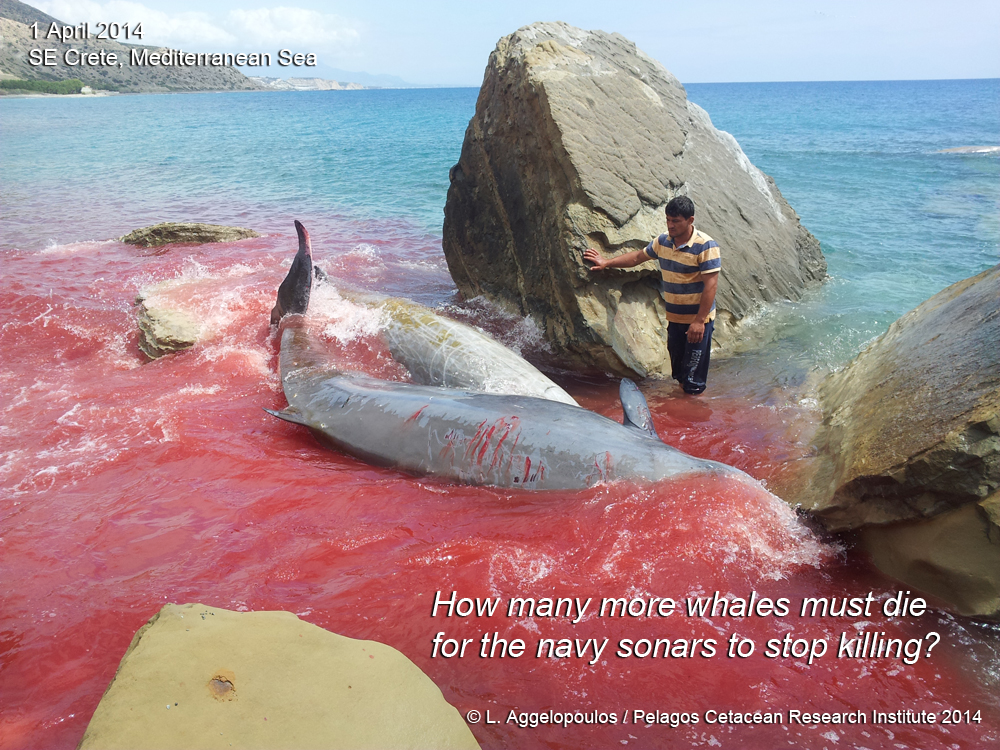
Dear Marmamers, Apparently attachments cannot pass through the Marmam list and we are receiving many requests for the photo that we tried to send to all of you. Those interested to have and distribute the photo in social media or elsewhere can download it from Giuseppe Notarbartolo di Sciara's Marine Conservation Blog and Website at the following link: http://www.disciara.net/?p=1010 Apologies for any inconvenience All best, Alexandros On 4/6/2014 5:13 PM, Alexandros Frantzis wrote:
Dear all,
Following the many tens of e-mails that we received, we would like to express our gratitude for your interest and support and answer some of your questions with an update, now that more data are available.
The atypical mass stranding spanned 2 days (1st and 2nd April ) and involved five single stranding events involving 3, 2, 1, 1 and 1 individuals. According to the analysis conducted so far, a minimum of five (but analysis is on going) and a maximum of seven individuals were recorded (two single standing events concerned the same individual and the two individuals of another event cannot be identified).
The distance between the western and eastern stranding locations for the strandings of the 1st April was 16.5 km in straight line. The single stranding of the 2nd of April occurred 4.1 km further west of the western stranding location of the 1st of April.
/(While writing this message and according to preliminary information from the local port-police authorities, three more reports of three different stranding events became available. They occurred the 3rd or 4th, the 5th and 6th April and all involved single animals. The two first concerned live animals re-floated and the last one (today 6th April) a dead animal still being on the beach. All of them occurred at a distance of less than 1 km between each other and took place in a location about 48 km west of the stranding event of the 2nd of April. These news are very important and indicate that the impact of the exercise may concern a very large sea area./)* * Two of the stranded whales died (all others were re-floated and not seen so far) and necropsies were performed on both of them (the whale that was disposed according to our first message was recovered). The necropsies were conducted under the guidance of Dr. Anastasia Komnenou, Veterinary School of Aristotle University of Thessaloniki. Please address any questions regarding the necropsies and the histopathological findings directly to her.
At least one of the photos of the stranding event is amazing and can greatly contribute to the conservation of beaked whales. Therefore, we thought that sharing it with the entire cetological community can help our common goal to protect the beaked whales from navy sonar and anthropogenic sound in general. Please feel free to upload and distribute the photo as attached to raise public awareness or for educational purposes (you have no right of use for commercial purposes).
All best, Alexandros -- ___________________________________________
Dr. Alexandros Frantzis Scientific director Pelagos Cetacean Research Institute Terpsichoris 21 16671 Vouliagmeni, GREECE Tel.: +30-210-8960108 e-mail:afrantzis@otenet.gr website:http://www.pelagosinstitute.gr ___________________________________________
--- This email is free from viruses and malware because avast! Antivirus protection is active. http://www.avast.com
participants (1)
-
 Alexandros Frantzis