New publication: Narwhal, beluga and bowhead whale responses to marine vessel traffic: A systematic map

Dear MARMAM, I am pleased to share with the marine mammal community our latest publication: Narwhal, beluga and bowhead whale responses to marine vessel traffic: A systematic map, published in Ocean and Coastal Management. You can access the article via this link: https://doi.org/10.1016/j.ocecoaman.2024.107251. We hope this paper will support research efforts towards understanding and mitigating the effects of Arctic shipping on Arctic whales. Abstract: The remote and harsh environment that endemic Arctic whales (bowhead, narwhal and beluga) reside in has so far limited their exposure to many human activities. However, Arctic industrialisation coupled with increasingly accessible ice-free waters means these species increasingly co-occur, and are exposed to, a number of potentially impactful activities, many of which are directly or indirectly associated with marine vessels. We conducted a systematic map, using five search databases, to ascertain the current level of understanding relating to how Arctic whales respond to marine vessels and vessel-associated activities. We identified a limited volume of literature (n = 169), and a disparity in volume between species, subpopulations, and vessel types. Several vessel types are increasingly present in the Arctic (e.g. cruise ships, fishing vessels), yet received limited consideration. Similarly, several endangered subpopulations have received little attention. Only with sufficient understanding of the associated impacts of vessels can we develop appropriate management and mitigation measures which can effectively conserve these unique, vulnerable and inherently valuable species. Any questions or feedback, please do get in touch, Emily and co-authors Emily Hague (She/her/hers) Marine Researcher www.emily-hague.com<http://www.emily-hague.com/> ·...¸><((((º> .··´¯`·.¸.·><((((º> ·.¸.·´¯`·...¸.·><((((º> Email: emilyhague@live.co.uk<mailto:emilyhague@live.co.uk> or elh2001@hw.ac.uk<mailto:elh2001@hw.ac.uk> Twitter: @emilyhague<https://twitter.com/emilyhague>
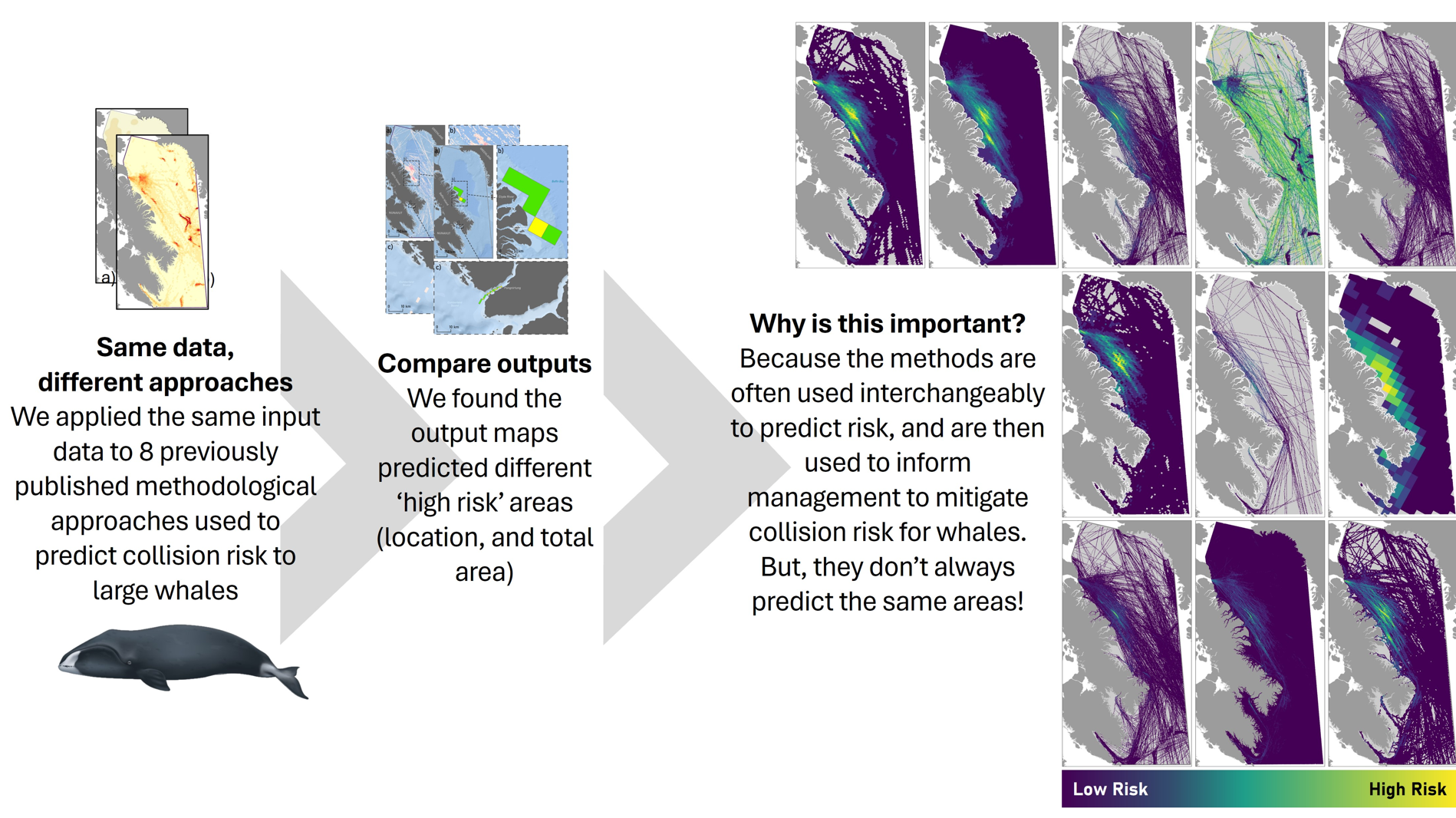
Dear MARMAM, I am pleased to share with the marine mammal community our latest publication: Not all maps are equal: Evaluating approaches for mapping vessel collision risk to large baleen whales, published in the Journal of Applied Ecology. You can access the article via this link: https://doi.org/10.1111/1365-2664.14794. We hope this paper will support research efforts towards predicting, understanding and mitigating whale-vessel collisions. Abstract: 1. A growing and increasingly globalised human population, requiring the movement of goods and commodities, is placing increasing demands on the maritime industry, resulting in a concurrent increase in global shipping activities. This has consequences for the marine environment, particularly for species vulnerable to the impacts of vessel traffic. For example, vessel collisions can result in sub-lethal or fatal injuries for marine mammals, whilst vessel noise can cause acoustic masking that effectively reduces an animal's listening space, potentially impacting their communication, navigation and foraging capacity. 2. While a number of parallel approaches to mapping collision risk to large whales have arisen, these methods vary in their focus, usually on either co-occurrence, collision probability, or probability of mortality. However, little attention has been given to the implications of methodological choice and data selection on subsequent risk predictions. 3. To assess differences between these approaches, we used a standardised input dataset comprised of telemetry-point data from tagged bowhead whales, and satellite-based Automated Identification System (AIS) data of spatial vessel movements covering the Davis-Baffin Arctic Marine Area. We applied this data to eight different, previously published analyses for deriving areas of vessel risk. 4. We found that the choice of risk mapping approach affected the location, and total area, identified as ‘high risk’, and that more computationally complex approaches did not necessarily equate to different predictions. There was considerable variation in the total area of ‘high risk’ predicted within each map (range = 20–42,246 km2). 5. Synthesis and Applications. The results underscore the importance of methodological transparency, informed data selection and careful interpretation when predicting collision risk. We provide practical recommendations for enhancing transparency when predicting risk, and discuss choice of approach suitable for different situations or management applications. It is critical that managers and policy makers are aware of the implications of applying different approaches when interpreting risk evaluation outputs. [cid:e49b770f-7ca4-4173-b920-98f65ea27072] Hague, E.L., Halliday, W.D., Dawson, J., Ferguson, S.H., Heide‐Jørgensen, M.P., Serra Sogas, N., Gormley, K., Young, B.G. and McWhinnie, L.H., 2024. Not all maps are equal: Evaluating approaches for mapping vessel collision risk to large baleen whales. Journal of Applied Ecology. https://doi.org/10.1111/1365-2664.14794 Any questions or feedback, please do get in touch, Emily and co-authors Emily Hague (She/her/hers) Marine Researcher www.emily-hague.com<http://www.emily-hague.com/> ·...¸><((((º> .··´¯`·.¸.·><((((º> ·.¸.·´¯`·...¸.·><((((º> Email: emilyhague@live.co.uk<mailto:emilyhague@live.co.uk> or elh2001@hw.ac.uk<mailto:elh2001@hw.ac.uk> Twitter: @emilyhague<https://twitter.com/emilyhague>
participants (1)
-
 Emily Hague