Humpback whale presence in Bali, Indonesia

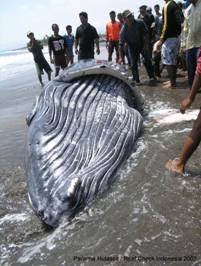
Reef Check Indonesia Press release Evidence of humpback whale presence in Bali, Indonesia Denpasar, October 5, 2007 Last Tuesday 2 October 2007 at 10am, a 6m whale lost its way offshore the Tanah Lot beach in Tabanan, Bali, entangled in drifted gillnets. Local villagers and government officials decided to haul the whale to the neighbouring Kedungu Beach and cut the nets there. After a few hours of rescue, the whale was finally set free and swam back to the sea around 2pm in the afternoon. However, despite all the uproar, the species ID of the whale was still in question; some sources identified the whale as blue whale (Balaenoptera musculus); a newspaper even named it pygmy killer whale (Feresa attenuata). Yet, the whale was actually a baby humpback whale (Megaptera novaeangliae or 'paus bongkok' in Indonesian), possibly separated from its mother while travelling. The humpback whale is a threatened species classified as 'Vulnerable' by the IUCN (International Union for Conservation of Nature and Natural Resources). But the most interesting thing is that this stranding event is the first evidence of humpback whale presence in Indonesia. In their 1997 paper ('Preliminary checklist of cetacea in the Indonesian Archipelago and adjacent waters') in the Zoologische Verhandelingen journal, Rudolph, Smeenk and Leatherwood decided that 'Pending irrefutable evidence, we regard the occurrence of three species as still unconfirmed: Stenella coeruleoalba, Balaenoptera acutorostrata and Megaptera novaeangliae.' Hence, the Tuesday stranding event and photographic evidence of the whale confirms that Indonesia does have humpback whales (Megaptera novaeangliae) roaming its archipelagic waters. Humpback whales are classified as baleen whales (sub order Mysticetes), i.e. having baleen or comb-like keratin plates in lieu of teeth to filter seawater for food. Together with blue whales (Balaenoptera musculus), fin whales (Balaenoptera physalus), sei whales (Balaenoptera borealis), Bryde's whale (Balaenoptera edeni), and minke whale (Balaenoptera acutorostrata), humpback whales belong to the family Balaenopteridae, also known as Rorquals. Yet, humpback whale is the only member of genus Megaptera, unlike other Rorquals that belong to genus Balaenoptera. The humpback whale is characterised by: knobs on head and lower jaw; distinctive, long flippers (upper side flippers are white for Atlantic humpback and black for Pacific humpback, under side flippers are white for both Atlantic and Pacific); irregular, wavy edges on flukes; and large, stocky body that is distinctively different from the streamlined body of other Rorquals. The shape of their flukes is used for individual identification. In Australia, humpback whales regularly conduct north-south migrations from Antarctica to Hervey Bay and Great Barrier Reef (eastern shores of Australia) and from Antarctica to Shark Bay and Ningaloo (western shores of Australia). Did the baby whale and its mother originate from one of the Western Australia pods? Or do they belong to other humpback pods, still unknown to cetacean (whale and dolphin) researchers in Indonesia? One thing is clear: more research is required to understand this magnificent species, often characterised by the elaborate singing performance by the males to attract the females. Another thing is also clear: Indonesia should be proud. The presence of humpback whale in the Archipelago, its existence long pondered and questioned, is just confirmed. By Putu Liza (Icha) and Pariama Hutasoit @ Reef Check Indonesia 2007 For more information, please contact: Pariama Hutasoit Reef Check Tourism and Education Program Manager Tel. : 0361-7981390 E-mail: phutasoit@reefcheck.org Or Putu Liza (putu.liza@jcu.edu.au)
participants (1)
-
 Putu Liza