New Review Paper on Cetacean Responses to Sonar

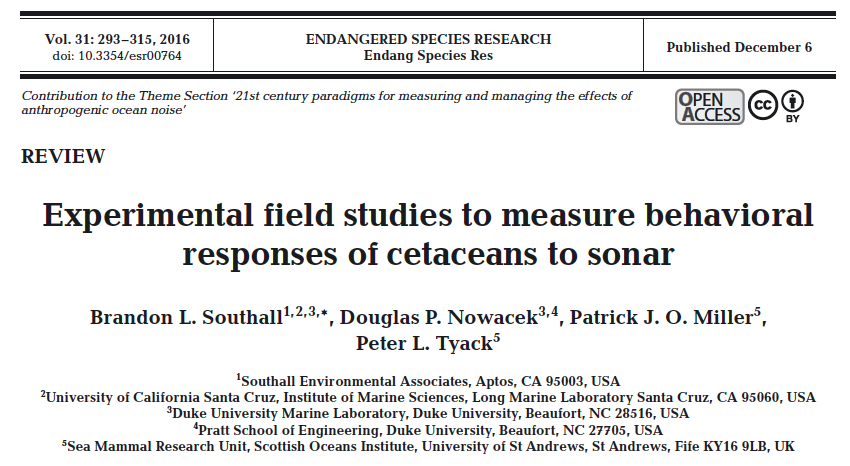
MARMAM subscribers, On behalf of my colleagues and co-authors (Doug Nowacek, Patrick Miller, and Peter Tyack), I am pleased to bring to your attention a recently-published paper in Endangered Species Research (ESR). This Open Access paper is entitled "Experimental field studies to measure behavioral responses of cetaceans to sonar" and it was published as a contribution to the ESR Theme Section " 21st Century Paradigms for Measuring and Managing the Effects of Anthropogenic Ocean Noise." The reference and abstract are given below. The contents page of the respective ESR volume (v.31) can be found at: http://www.int-res.com/abstracts/esr/v31/ and the article itself is available at: http://www.int-res.com/abstracts/esr/v31/p293-315/ or upon email request. Thank you, Brandon Southall and co-authors ABSTRACT: Substantial recent progress has been made in directly measuring behavioral re - sponses of free-ranging marine mammals to sound using controlled exposure experiments. Many studies were motivated by concerns about observed and potential negative effects of military sonar, including stranding events. Well-established experimental methods and increasingly sophisticated technologies have enabled fine-resolution measurement of many aspects of baseline behavior and responses to sonar. Studies have considered increasingly diverse taxa, but primarily odontocete and mysticete cetaceans that are endangered, particularly sensitive, or frequently exposed to sonar. This review focuses on recent field experiments studying cetacean responses to simulated or actual active military sonars in the 1 to 8 kHz band. Overall results demonstrate that some individuals of different species display clear yet varied responses, some of which have negative implications, while others appear to tolerate relatively high levels, although such exposures may have other consequences not measured. Responses were highly variable and may not be fully predictable with simple acoustic exposure metrics (e.g. received sound level). Rather, differences among species and individuals along with contextual aspects of exposure (e.g. be - havioral state) appear to affect response probability. These controlled experiments provide critically needed documentation of identified behavioral responses occurring upon known sonar exposures, and they directly inform regulatory assessments of potential effects. They also inform more targeted opportunistic monitoring of potential responses of animals during sonar operations and have stimulated adaptations of field methods to consider increasingly realistic exposure scenarios and how contextual factors such as behavioral state and source proximity influence response type and probability. KEY WORDS: Behavioral response study · Sonar · Marine mammals · Controlled exposure experiment
participants (1)
-
 Brandon Southall